Why trade show lead follow-up determines your success
A trade show often represents months of preparation.
The stand is designed, materials are arranged, and the team gets prepared. Then suddenly, you are there. Three days full of conversations, handshakes, and discovering who might be interested in your product or service. During the event itself, the energy is high. You speak with many people and it feels like real opportunities are being created.
And then, just like that, it is over.
What happens afterwards ultimately determines whether the entire investment was worth it. Yet this is still the part that often receives the least attention. Leads are collected, but follow-up is delayed or forgotten altogether. A missed opportunity — because this is where the real results are created.
A successful trade show does not end after day three
During the event, everything seems to revolve around the moment itself: having conversations, attracting visitors, and presenting your story.
But especially at B2B trade shows, most decisions are not made on the exhibition floor. People are exploring, comparing options, and then returning to their daily work. And honestly, after several days filled with impressions, many visitors no longer remember exactly which stand told them what.
There is little you can do about that except making sure your company reappears at the right moment.
You may have had a great conversation, but if there is no follow-up afterwards, the connection fades away. Not because there was no interest, but because the moment passed.
Badge scanning or business cards?
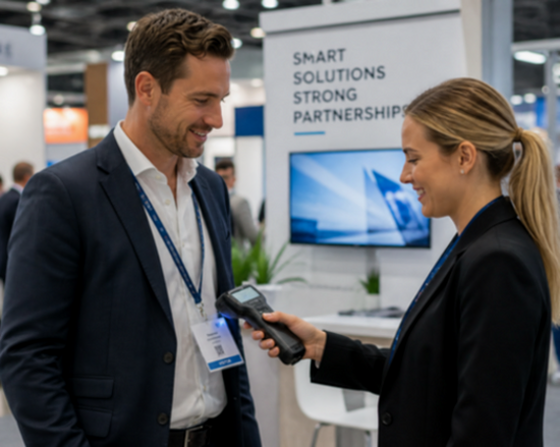
At most trade shows, organisers provide badges with names and QR codes. One quick scan and all contact details are stored immediately.
It is fast and efficient, especially during busy moments on the stand when there is no time to manually write down leads.
At the same time, many exhibitors still prefer working with business cards. It feels more personal, and often someone consciously hands over a card instead of simply allowing their badge to be scanned.
Both methods have advantages and disadvantages. Scanning is more efficient, but sometimes lacks context. Business cards create more personal connection, but require more manual processing afterwards.
In practice, the chosen method matters less than what happens afterwards. The most important thing is that the contacts made during the exhibition are actually followed up on.
Without context, leads quickly become anonymous
One thing that is often underestimated is the importance of capturing context. A name and email address are useful, but by themselves they say very little especially a few days later when reviewing a long list of leads.
If you no longer remember the conversation, follow-up becomes difficult. The result is usually a generic email, and visitors notice that immediately.
A short note already makes a huge difference. Simply writing down what someone was looking for, what challenge they mentioned, or what was discussed during the conversation.
It does not need to be a detailed report. A few keywords are often enough to trigger the memory again.
And that immediately improves the quality of the follow-up. When someone notices that you still remember the conversation clearly, they feel recognised and valued. That is often exactly the difference between receiving a reply or being ignored.
Think about follow-up before the trade show starts
What often happens is that companies only start thinking about follow-up after the event has ended. Suddenly, something needs to be created for all the collected leads while everyone is already busy catching up on other work after being away from the office for several days.
Preparing beforehand makes everything much easier. You already know what will be sent and why. During the trade show itself, conversations can already be aligned with that next step.
It does not have to be complicated. For example:
- a demo or consultation session
- a temporary promotion or discount
- an exclusive pre-order opportunity for visitors
- a physical giveaway
- a free trial period.
Small extras can make a big difference
Trade show visitors process an enormous amount of information in a short time. Many conversations, many impressions, and many companies all competing for attention.
That is exactly why small extras can help your company stand out. Something memorable that gives visitors a reason to think about your brand again afterwards.
It does not need to be large or expensive it simply needs to fit your company and the audience you are speaking to.
Keep the process manageable
You do not need to overcomplicate lead follow-up. In fact, the simpler the process is, the more likely it is to actually happen.
Create overview and structure. Know which leads are most valuable and make clear who is responsible for what. And simply start even if not everything is fully perfected yet.
In practice, that often works better than an extensive strategy that never gets executed.
The goal is simple: follow up, show that you remember the conversation, and offer something relevant to the other person.
When that happens, a contact becomes more than just another name on a list. It becomes the beginning of a deal.
The real difference is made afterwards
And that is exactly where the real value of a trade show is created not necessarily on the exhibition floor itself, but in the days afterwards.
The companies that respond quickly, communicate personally, and stay relevant are the ones that get the most out of all the effort invested beforehand.
Good follow-up should not feel like sales. It should feel like the natural continuation of a valuable conversation.
So give yourself that final step. Schedule time after the exhibition, divide the leads properly, and make sure momentum continues.
Because no matter how impressive your stand was, how busy the exhibition became, or how many conversations you had…
Without follow-up, it ends there.
With the right follow-up, it turns into results.
Curious how we translate your specific wishes into a stand design? Make an appointment.